Supporting Your Student at Home: Practical Strategies for DLI Success

Your home is your child's first classroom, and the support you provide at home is just as important as what happens in the DLI classroom. Parents don't need to be bilingual or have formal teaching training to make a significant impact on their child's learning. What matters most is creating a language-rich, literacy-focused home environment and maintaining consistent routines that support learning.
Creating a Language-Rich Home Environment
1. Read Together Every Day
Reading is the foundation of literacy development in both languages. Make reading a daily habit:
- Read picture books aloud to younger children
- Read chapter books with older children
- Visit your local library regularly and let your child choose books
- Read bilingual books that reflect your family's culture and languages
- Ask questions about the story to develop comprehension
- Reread favorite books—repetition builds vocabulary and confidence
If you're not fluent in the target language, read in English and encourage your child to read in the target language. Your child can read to you and explain the story.
2. Talk and Listen
Conversation is powerful language development. Make time for meaningful conversations:
- Ask open-ended questions that require more than yes/no answers
- Listen actively without interrupting
- Expand on what your child says ("You saw a bird? What color was it? What was it doing?")
- Talk about your day, your feelings, and your experiences
- Play word games and rhyming games
- Tell stories about your family history and culture
3. Use Both Languages at Home
If your family speaks the target language at home, maintain that practice. If your family primarily speaks English, you can still support bilingual development:
- Use target language labels for common objects
- Learn key phrases in the target language to use with your child
- Watch shows or listen to music in the target language together
- Celebrate the target language as a valuable family asset
- Connect the target language to your family's cultural heritage
4. Create a Print-Rich Environment
Surround your child with written language:
- Display books, magazines, and newspapers around your home
- Label objects in your home in both languages
- Create a family message board
- Post family photos with captions
- Display your child's artwork and writing
- Keep a family calendar visible
Supporting Academic Learning at Home
1. Establish Consistent Routines
Routines create structure and predictability that support learning:
- Establish a consistent homework time and place
- Create a bedtime routine that includes reading
- Set aside time for family conversations
- Limit screen time and prioritize interactive activities
- Create a morning routine that includes time for breakfast and conversation
2. Help with Homework Strategically
Your role in homework support is to guide, not to do the work for your child:
- Create a quiet, distraction-free homework space
- Help your child understand what's being asked, then let them solve it
- Ask questions that guide thinking ("What do you think comes next? Why?")
- Celebrate effort and persistence, not just correct answers
- Communicate with the teacher if homework is consistently too difficult
- Don't do the work for your child—struggle is part of learning
3. Support Bilingual Literacy Development
- Encourage your child to write in both languages
- Create opportunities for authentic writing (thank you notes, letters to family, lists)
- Read your child's writing without focusing on spelling and grammar
- Celebrate writing attempts, even if they're not perfect
- Help your child see themselves as a writer and reader in both languages
4. Connect Learning to Real Life
Help your child see how school learning applies to real life:
- Cook together and talk about measurements and ingredients
- Go to the store and practice math and vocabulary
- Visit museums, parks, and cultural events
- Explore nature and discuss what you observe
- Watch age-appropriate documentaries together
- Connect current events to what your child is learning
Supporting Your Child's Social and Emotional Growth
1. Foster a Growth Mindset
Help your child understand that abilities develop through effort:
- Praise effort and strategy, not innate ability ("You worked hard on that!" not "You're so smart!")
- Normalize mistakes as part of learning
- Model a growth mindset in your own learning
- Encourage your child to try new things and take risks
- Help your child see challenges as opportunities to grow
2. Create a Safe Space to Practice Language
Your home should be a place where your child feels safe taking risks with language:
- Don't correct pronunciation or grammar constantly
- Celebrate attempts to use language, even if imperfect
- Model correct language use without explicit correction
- Create opportunities for your child to practice language without judgment
- Celebrate code-switching as a sign of bilingual development
3. Build Confidence and Identity
- Celebrate your family's cultural heritage and languages
- Share stories about your family history
- Introduce your child to role models who are bilingual
- Affirm that being bilingual is a strength and asset
- Help your child see themselves as a capable learner and bilingual person
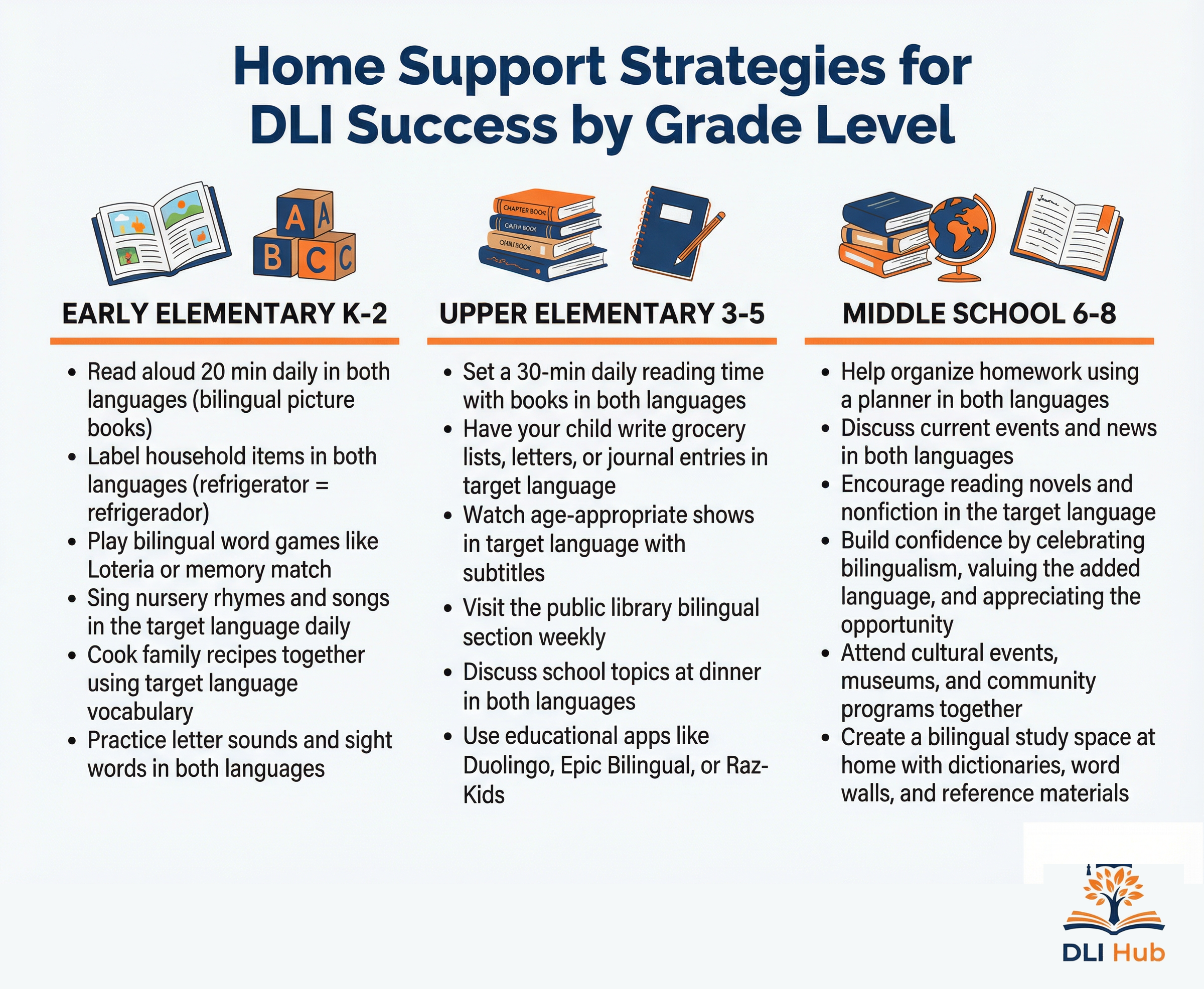
Practical Strategies for Different Ages
Early Elementary (K-2): - Focus on phonemic awareness and letter recognition in both languages - Read aloud daily - Play rhyming and word games - Practice writing letters and simple words - Limit homework support—keep it brief and positive
Upper Elementary (3-5): - Continue daily reading, gradually moving toward independent reading - Support reading comprehension through discussion - Encourage writing for authentic purposes - Help with homework while maintaining high expectations for independence - Connect learning to your child's interests
Middle School (6-8): - Support independent reading and writing - Help your child organize and manage homework - Discuss what your child is learning and connect to real world - Model lifelong learning and curiosity - Build confidence by celebrating bilingualism, valuing the added language, and appreciating the opportunity
Overcoming Common Challenges
"My child refuses to speak the target language at home."
This is common and normal. Don't force it. Continue to use the target language, read in it, and celebrate it as a family asset. Your child will return to it when they're ready.
"I'm not fluent in the target language."
You don't need to be fluent to support your child's learning. Read in English, encourage your child to read in the target language, learn key phrases together, and celebrate your child's bilingual development.
"Homework is a battle."
Communicate with the teacher. Homework should support learning, not create stress. Work together to find solutions that work for your family.
"My child is stronger in one language than the other."
This is normal and expected. Continue to support both languages. Your child will develop balanced proficiency over time with consistent support.
The Power of Home Support
Research consistently shows that family involvement and support at home is one of the strongest predictors of academic success. In DLI programs, this support is particularly important because you're supporting bilingual development—a complex, long-term process that requires consistent reinforcement across contexts.
You don't need to be a teacher or be fluent in the target language to make a significant impact. What matters most is creating a home environment that values learning, celebrates bilingualism, maintains consistent routines, and provides your child with the message that education and language development are family priorities.