Assessing Bilingual Learners: Beyond the Standardized Test
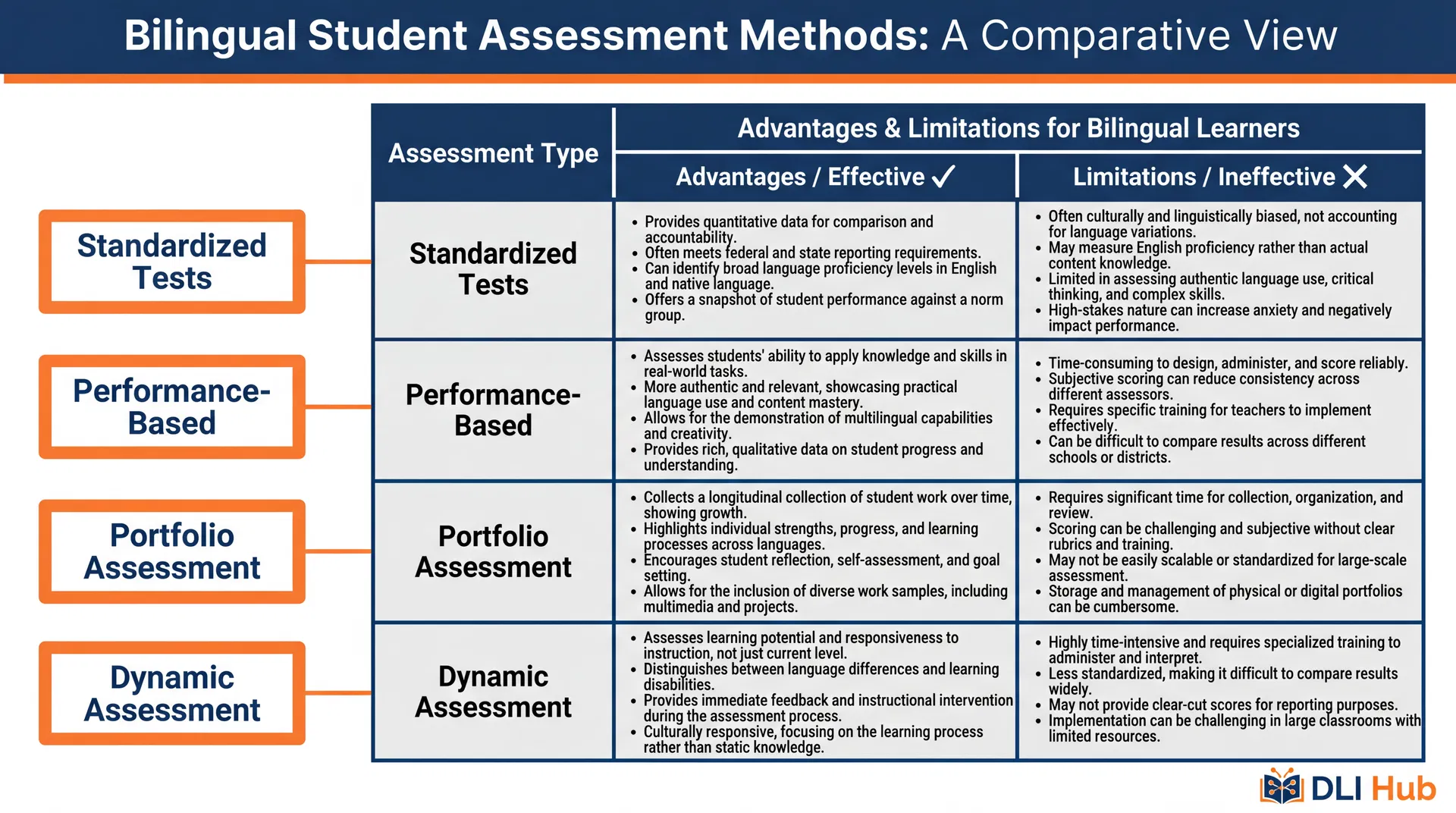
Here's a problem many DLI educators face: standardized tests don't measure bilingual proficiency. A student might be highly proficient in Spanish but score below grade level on an English reading test—not because they can't read, but because they haven't yet developed academic English proficiency. Traditional assessments miss the full picture.
Why Standardized Tests Aren't Enough
Standardized tests measure performance in a single language at a single point in time. For bilingual students, this creates a distorted view:
- A student's total vocabulary across both languages is much larger than in either language alone
- Conceptual knowledge developed in one language transfers to the other
- Bilingual students may code-switch strategically—a sign of linguistic sophistication, not confusion
- Academic proficiency develops differently in bilingual contexts
Alternative Assessment Strategies
1. Dynamic Assessment
Dynamic assessment measures a student's learning potential by observing how they respond to instruction and feedback. Instead of just measuring what they know, it shows what they can learn with support. This is especially valuable for identifying true language disorders versus language difference.
2. Portfolio Assessment
Collect work samples in both languages over time. Portfolios show growth trajectories, allow students to demonstrate proficiency in authentic contexts, and reveal strengths that single-point assessments miss.
3. Bilingual Vocabulary Assessment
Measure vocabulary across both languages combined. Many bilingual students have smaller vocabularies in each language but larger total vocabularies than monolingual peers. Assessing only English vocabulary underestimates their true language development.
4. Observational Assessment
Systematic observation of student language use in authentic contexts—during group work, play, problem-solving—reveals proficiency that formal tests don't capture. Look for code-switching patterns, narrative ability, and pragmatic language use.
5. Criterion-Referenced Assessment
Instead of comparing bilingual students to monolingual norms, assess them against bilingual proficiency standards. What should a bilingual student at this grade level be able to do in each language? This reframes assessment from deficit to growth.
Practical Implementation
You don't need to abandon standardized tests entirely. Instead, use them as one data point within a comprehensive assessment system:
- Administer standardized tests in both languages when possible
- Supplement with dynamic and portfolio assessments
- Use observational data to contextualize test scores
- Involve families in assessment—they observe language development at home
- Disaggregate data by language to see the full picture
The Bottom Line
Bilingual students are not two monolingual students in one body. They're integrated language users with a unique linguistic profile. Assessment practices should reflect this reality. When we move beyond single-language, single-point assessments, we see the true capabilities of our bilingual learners.