Elevating DLI Pedagogy: Instructional Integration Strategies to Accelerate Student Learning
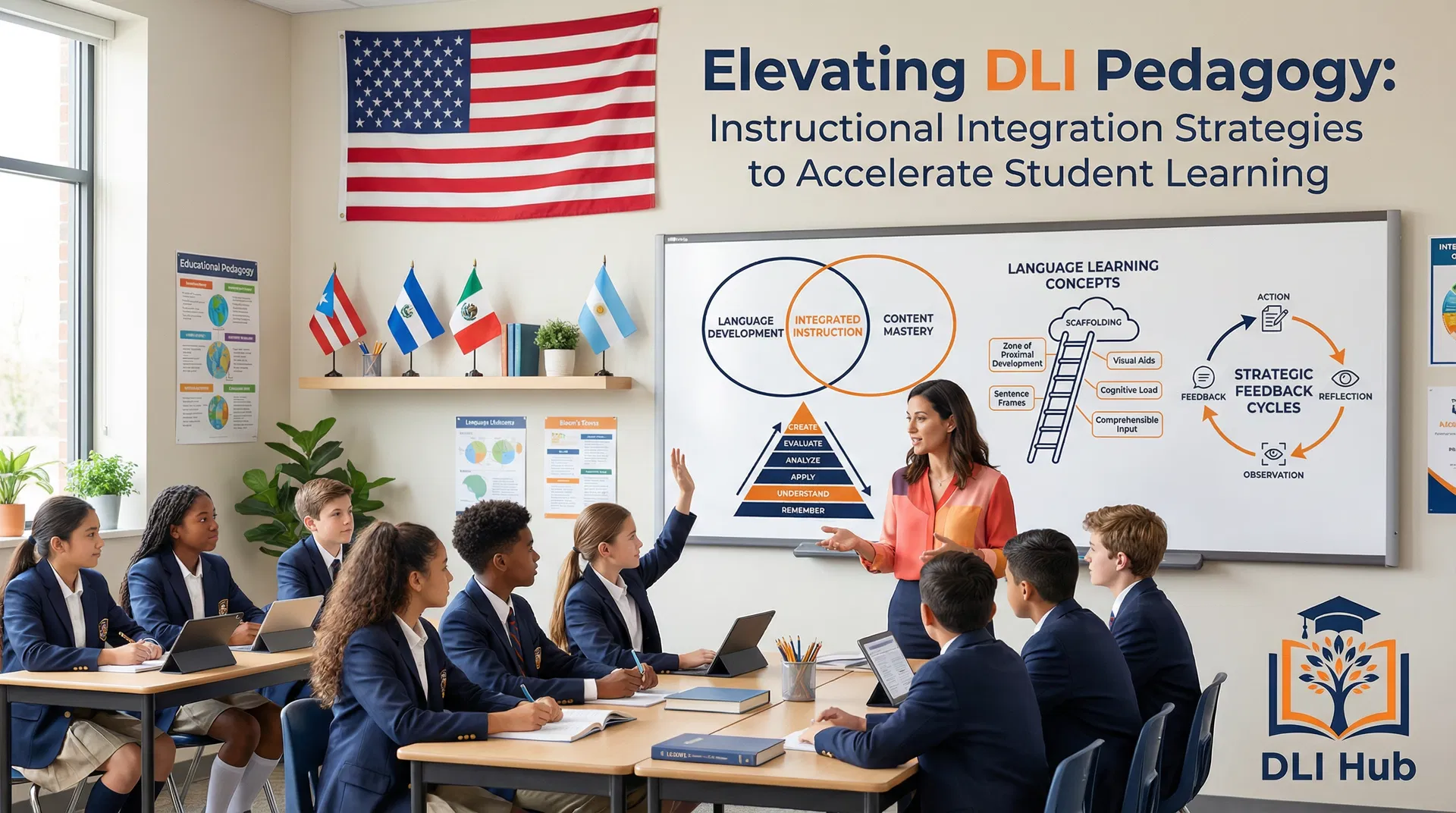
The success of dual language immersion programs hinges not just on exposure to two languages, but on how teachers strategically integrate language development with rigorous content instruction. Effective DLI pedagogy requires teachers to be architects of learning experiences where language and content are inseparable, where every lesson becomes an opportunity to develop biliteracy while advancing academic mastery.
The Three Pillars of Effective DLI Instruction
1. Language-Integrated Content Instruction
Teaching content (math, science, social studies) in ways that explicitly develop language skills while maintaining academic rigor. When teachers design lessons with both language and content objectives, students develop academic vocabulary, complex syntax, and conceptual understanding simultaneously.
Implementation strategies: - Pre-teach academic vocabulary in both languages before content lessons - Use sentence frames and language scaffolds that allow students to express complex ideas - Incorporate think-aloud protocols where you model language use while solving problems - Create word walls organized by content area and language function - Use cooperative learning structures that require students to produce language
2. Strategic Feedback and Assessment for Language Development
Providing targeted feedback that advances both language proficiency and content understanding, using assessment as a tool for learning rather than just measurement. Students need to know not just whether their answer is correct, but *how* to express it more accurately in both languages.
Implementation strategies: - Use formative assessment daily through exit tickets and observation notes - Provide corrective feedback that models, not just corrects - Celebrate approximations and risk-taking - Use rubrics that separate language and content criteria - Implement peer feedback protocols where students learn to give constructive feedback
3. Creating a Language-Rich, Cognitively Demanding Environment
Designing classroom spaces, routines, and interactions that demand higher-order thinking while supporting language production. Cognitive demand and language demand must go hand-in-hand.
Implementation strategies: - Use Bloom's Taxonomy and Depth of Knowledge frameworks to ensure high-cognitive tasks - Implement "wait time" after asking questions—give students 5-10 seconds to think - Use visual supports extensively: graphic organizers, anchor charts, diagrams - Establish language routines and protocols that students can use predictably - Rotate language of instruction strategically to ensure both languages are used for high-cognitive content
Accelerating Student Learning: Five Evidence-Based Practices
1. Explicit Language Instruction Within Content
Don't assume students will pick up academic language through exposure alone. Teach it explicitly by highlighting and explaining academic language in context, comparing conversational with academic language, practicing using new language in multiple contexts, and reviewing and recycling language across units.
2. Balanced Literacy in Both Languages
Ensure students develop reading and writing proficiency in both languages through guided reading groups in both languages, teaching reading comprehension strategies in both languages, having students write for authentic purposes, and using bilingual literature that reflects students' cultures.
3. Collaborative Learning Structures
Peer interaction accelerates language development and deepens content understanding. Use structured protocols that ensure all students participate, assign rotating roles, teach students how to ask clarifying questions, and monitor group dynamics for equitable participation.
4. Culturally Sustaining Pedagogy
Connect content to students' cultural backgrounds by using texts that reflect diverse cultures, inviting families to share cultural knowledge, celebrating multilingualism as an asset, and creating space for students to see themselves in the curriculum.
5. Data-Informed Instruction
Use assessment data to continuously refine your practice by analyzing student work samples, using running records and fluency assessments, tracking student growth over time, and adjusting instruction based on what data reveals about student needs.
Overcoming Common Challenges
*Challenge:* "I'm not a language teacher—I teach math/science."
*Reality:* In a DLI classroom, every teacher is a language teacher. Partner with your dual language coach or specialist to co-plan lessons that integrate language and content objectives.
*Challenge:* "There's not enough time to teach everything."
*Reality:* When language and content are integrated, you're not adding time—you're maximizing the time you have.
*Challenge:* "Some students are much stronger in one language than the other."
*Reality:* This is normal and expected. Use students' stronger language as a bridge to their weaker language.
Reflection Questions for Your Practice
- How intentionally am I integrating language objectives with content objectives?
- What language scaffolds am I providing to support students in expressing complex ideas?
- How am I using assessment data to inform my instruction?
- Am I creating opportunities for students to use language for higher-order thinking?
- How am I celebrating and leveraging students' multilingualism as an asset?
Conclusion
Elevating DLI pedagogy means moving beyond simply teaching *in* two languages to strategically designing instruction that accelerates learning in both languages and all content areas. When teachers integrate language development with cognitively demanding content, provide targeted feedback, and create language-rich environments, students don't just become bilingual—they become bilingual learners who think deeply, communicate effectively, and achieve at high levels.
The strategies outlined in this blog are not add-ons to your teaching practice. They are the foundation of effective DLI instruction. By implementing even one or two of these practices with intention and consistency, you'll see accelerated growth in both language proficiency and academic achievement.